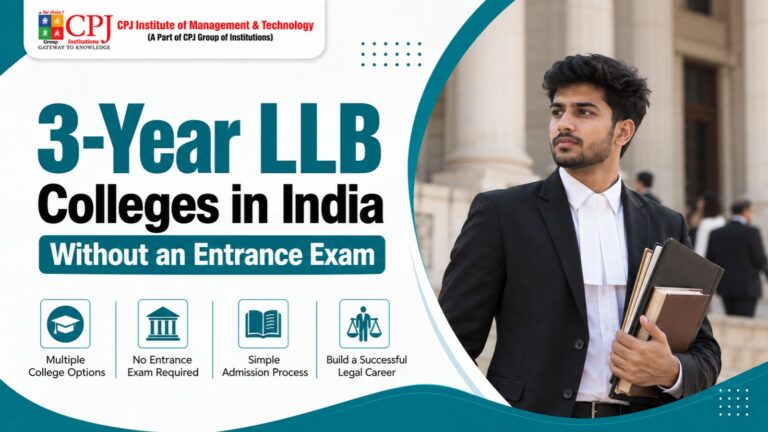
Graduation ke baad law ki field mein career banana chahte hain, lekin CLAT ya kisi entrance exam ki preparation nahi karna chahte? A three-year LL.B course can be a suitable option for graduates who want to enter legal education without starting a five-year integrated programme again.
Many students search for Direct Admission in 3-Year LL.B Colleges in Delhi to find colleges where admission is based on graduation marks, personal interviews or merit instead of competitive entrance examinations. However, direct admission rules are different at every institution. Some colleges accept applications through merit and interviews, while others require entrance tests or university counselling.
Delhi NCR has private law colleges in Delhi, Noida, Greater Noida and Ghaziabad offering three-year LL.B programmes. Before applying, students should compare eligibility, fees, degree-awarding university, BCI approval and practical learning facilities.
What Is a 3-Year LL.B Course?
The three-year LL.B (Bachelor of Laws) is a graduate-entry law programme. Students must complete a bachelor’s degree before applying for this course. It generally consists of three academic years and six semesters.
Students study different areas of law, including:
- Constitutional Law
- Law of Contract
- Criminal Law
- Civil Procedure
- Family Law
- Property Law
- Company Law
- Jurisprudence
- Legal Research and Drafting
Along with classroom subjects, legal education also involves case studies, moot courts, internships, legal writing and research activities, depending on the university’s curriculum.
Difference Between 3-Year LL.B and 5-Year BA LL.B
| Course | Admission After | Duration |
| 3-Year LL.B | Graduation | 3 years |
| BA LL.B | Class 12 | 5 years |
| BBA LL.B | Class 12 | 5 years |
A three-year LL.B is suitable for graduates from different academic backgrounds. The five-year integrated law courses are designed for students who want to study law immediately after Class 12.
Private LL.B Colleges in Delhi NCR for Direct Admission
Several private law colleges around Delhi NCR offer three-year LL.B courses. However, admission without an entrance exam is not available at every college. The following comparison helps graduates understand the different admission routes.
College Comparison Table
| College & Location | University / Affiliation | Eligibility & Admission Route | BCI Status | Latest Fee |
| CPJIMT, Narela, Delhi | Awarding university not clearly specified on current course page | 45% graduation; direct admission & personal interaction, as stated by institute | Institute claims approval; current course/session document to verify | Not officially published |
| Lloyd Law College, Greater Noida | CCSU, Meerut | 50% graduation / accepted scores; LET and interview | Approval published through 2026–27; next session verify | Current fee to confirm |
| Asian Law College, Noida | CCSU, Meerut | 45% graduation; ALCAT or CLAT score | College states BCI approval | 2025–26 fee available through enquiry |
| Global College of Law, Ghaziabad | CCSU, Meerut | 45% graduation; 40% SC/ST; merit-based | BCI approval for 2026–27 | ₹45,000/year (2026–27) |
| HLM Law College, Ghaziabad | CCSU, Meerut | 45% general; 40% SC/ST; merit/counselling | College states BCI approval | As per university/state norms; confirm |
| Milestone Institute of Law, Ghaziabad | CCSU, Meerut | Graduate eligibility; check current criteria | College states BCI recognition | As per university guidelines |
| IAMR Law College, Ghaziabad | CCSU, Meerut | Graduation; confirm latest admission rules | College states BCI approval | Confirm with college |
| Indcare College of Law, Greater Noida | CCSU, Meerut | Graduate eligibility; merit & personal interview | College states BCI approval | Confirm with college |
| CPJ College of Higher Studies & School of Law, Narela, Delhi* | GGSIPU | University entrance/counselling route | Verify current programme approval | ₹1,15,000 tuition (2026; university charges extra) |
Fees are based on the latest identifiable published information. The 2027–28 fees and course approvals should be confirmed directly with the respective colleges before applying.
1. CPJ Institute of Management & Technology (CPJIMT), Narela
CPJ Institute of Management & Technology offers a three-year LL.B programme for graduates interested in pursuing legal education after completing their bachelor’s degree. Located in Narela, Delhi, the institute provides an option for students looking for a law course within Delhi NCR.
The published eligibility criteria for CPJIMT LL.B admission include:
- Graduation from a recognised university.
- Minimum 45% marks in graduation.
- Fulfilment of the institute’s admission and document verification requirements.
The institute’s admission information advertises direct admission based on personal interaction without an entrance test. Applicants should confirm the current admission procedure for their particular session before submitting their application.
Students can explore the CPJIMT 3-Year LL.B programme for course details, eligibility information and legal career pathways.
Direct Admission in 3-Year LL.B at CPJIMT
For students who do not want to appear for an entrance examination, CPJIMT’s published admission information describes a personal-interaction-based selection process.
The general admission steps include:
- Submit the application or admission enquiry.
- Share graduation marksheets and qualification details.
- Check eligibility with the admissions team.
- Complete the personal interaction/interview as applicable.
- Submit the required documents for verification.
- Confirm admission after receiving the applicable admission details and fee instructions.
Direct admission does not mean admission is guaranteed. Students must meet eligibility conditions and complete the admission requirements.
Practical Learning at CPJIMT
Law students need to learn how to understand legal provisions, examine case facts and prepare arguments. Practical learning is an important part of developing these skills.
CPJIMT’s published programme information discusses learning areas such as:
- Legal research and case-law analysis
- Legal drafting and documentation
- Case studies and legal reasoning
- Understanding constitutional and statutory provisions
- Moot court activities, where available
Students should also enquire about the internship structure, court visits, legal aid activities, practical training, placement assistance and career guidance available specifically to LL.B students.
Degree Recognition and BCI Approval
Before taking admission, students must verify the degree-awarding university, affiliation and Bar Council of India (BCI) approval for the exact three-year LL.B programme and academic session.
CPJIMT’s website publishes institutional recognition claims and details of its LL.B programme. However, the exact degree-awarding university and programme-specific BCI approval for the intended admission session should be obtained and checked through official documents before paying fees.
Students can check the CPJIMT eligibility and admission requirements and ask the institute for the latest affiliation and approval documents.
2. Lloyd Law College, Greater Noida
Lloyd Law College offers a three-year LL.B programme for graduates interested in litigation, legal practice and judiciary preparation. Its course includes theoretical and practical legal education.
The college is affiliated with Chaudhary Charan Singh University, Meerut, and publishes BCI approval information. Its current admission process includes the Lloyd Entrance Test (LET), accepted entrance scores where applicable and a personal interview.
Lloyd is an option for graduates who want to study law in Greater Noida and explore practical training, moot courts, legal skills and judiciary-related learning. Check the current eligibility and fee structure before applying.
3. Asian Law College, Noida
Asian Law College, located in Sector 125, Noida, offers a three-year LL.B programme affiliated with CCS University, Meerut. The college states that the programme is approved by the Bar Council of India.
Its published eligibility criteria include graduation in any discipline with 45% marks. The college also lists a 40% requirement for specified reserved categories under applicable rules.
Admission to its three-year LL.B programme includes the Asian Law College Admission Test (ALCAT), while CLAT scores are also accepted as mentioned in its admission information.
The college lists moot courts, court visits, legal seminars, workshops and research activities. The exact fee for the 2025–26 session is available through its enquiry process.
4. Global College of Law, Ghaziabad
Global College of Law is situated near Dasna, Ghaziabad, and offers a three-year LL.B programme affiliated with CCS University. It publishes BCI approval information for its law courses.
The college lists graduation with 45% marks as the LL.B eligibility requirement and 40% for SC/ST candidates. Its admission information for 2026–27 states that admission is merit-based and completed through university registration and document verification.
The published LL.B fee is ₹45,000 per year for 2026–27, including CCSU examination and enrolment fees as stated by the college. Confirm additional charges, admission deadlines and the approval applicable to the 2027 session.
5. HLM Law College, Ghaziabad
HLM Law College offers a three-year LL.B programme affiliated with CCS University, Meerut. The college states that its law programme is approved by the Bar Council of India.
The eligibility requirements published on its course page include graduation in any discipline with 45% marks for general category and 40% for SC/ST candidates.
Its admission procedure includes application, document submission, counselling and merit selection. Students can also check the college’s moot court facilities, law library, legal workshops and court exposure opportunities while comparing it with other private LL.B colleges in Delhi NCR.
6. Milestone Institute of Law, Ghaziabad
Milestone Institute of Law offers a three-year LL.B programme and a five-year BA LL.B course. Its official information states that the institute is affiliated with CCS University, Meerut, and recognised by the Bar Council of India.
Students should check the latest LL.B admission notice for the current graduation percentage, merit requirements, seat availability, university registration, fee schedule and document submission dates.
The institute publishes notices related to vacant LL.B seats and semester fee/examination processes, so applicants should follow the latest college announcements before proceeding.
7. IAMR Law College, Ghaziabad
IAMR Law College lists a three-year full-time LL.B programme divided into six semesters. Its official course information states affiliation with CCS University, Meerut, and BCI approval.
The college’s legal education facilities include a law library, moot court and legal aid clinic. Graduates should confirm the current eligibility criteria, application route, fee structure and selection procedure for the intended session.
8. Indcare College of Law, Greater Noida
Indcare College of Law, situated in Knowledge Park III, Greater Noida, offers a three-year LL.B programme. Its official FAQ states that it is affiliated with CCS University, Meerut, and approved by the Bar Council of India.
The admission process for its three-year LL.B is described as merit-based with a personal interview. Students should confirm the minimum graduation percentage, current fee, seat availability, required documents and admission dates before applying.
What Is Direct Admission in LL.B?
Direct admission in LL.B usually refers to a college-specific admission process that may not require a central entrance examination. Depending on the institution, candidates can be selected through graduation marks, merit, personal interviews, counselling or another approved selection process.
| Admission Type | Selection Method |
| Merit-based | Graduation percentage or academic record |
| Interview-based | Personal interaction with the admission committee |
| Entrance-based | Entrance examination score or rank |
| University counselling | Central registration, college preferences and seat allotment |
| Direct admission | Institution’s own selection route, subject to eligibility |
Direct admission is not the same as guaranteed admission. Applicants must meet the academic requirements and complete the prescribed selection process.
LL.B Admission Without Entrance Exam in Delhi
Yes, LL.B admission without entrance exam is possible at some private colleges where the current selection process allows merit or interview-based admission. But several universities and colleges use entrance tests or centralised counselling.
For example, CPJIMT currently advertises direct admission based on personal interaction without an entrance examination. Lloyd uses an entrance/interview process, while Asian Law College lists ALCAT or CLAT scores for the three-year LL.B.
If you are looking for more options, CPJIMT’s 3-Year LL.B colleges without entrance exam guide explains the difference between merit-based, entrance-based and college-specific admission routes.
Students who have not appeared for CLAT can also read how to pursue law in India without CLAT to understand alternative law course and admission options.
Documents Required for LL.B Admission After Graduation
Graduates should keep the following documents ready for the admission process:
- Class 10 marksheet and certificate
- Class 12 marksheet and certificate
- Graduation marksheets of all semesters or years
- Graduation degree or provisional certificate
- Aadhaar card or other accepted identity proof
- Passport-size photographs
- Transfer certificate
- Migration certificate, if required
- Category certificate, if applicable
- Entrance exam scorecard, if applicable
Some colleges may require additional documents, affidavits or undertakings. Always check the college’s official admission checklist.
How to Apply for LL.B Admission 2027
Follow these steps when applying for LL.B admission 2027:
- Shortlist colleges offering a three-year LL.B programme.
- Check graduation eligibility and minimum marks.
- Confirm whether the college requires an entrance test.
- Fill in the college application form.
- Submit academic documents and identity proof.
- Attend the entrance test, personal interview or counselling if required.
- Review the admission offer and complete verification.
- Pay the applicable fee within the admission deadline.
Admission dates for 2027 may vary across colleges. Do not rely on previous year’s deadlines as confirmed dates for the upcoming session.
How to Choose a 3-Year LL.B College in Delhi NCR
Before selecting a college, compare the following factors:
- BCI approval: Check the approval for the exact LL.B course, session and intake.
- University affiliation: Confirm which university awards the degree.
- Faculty: Review teaching experience and legal subject expertise.
- Moot court: Look for opportunities to practise arguments and courtroom procedure.
- Internships: Ask about internships with advocates, law firms, companies and legal organisations.
- Court visits: Check whether students get exposure to actual legal proceedings.
- Library: Review access to law books, journals and legal databases.
- Fees: Compare the complete three-year cost.
- Career support: Ask about internships, legal career guidance and placement assistance.
You can also explore CPJIMT’s law colleges in Delhi NCR guide for broader information about legal education options and college selection.
Career Opportunities After a 3-Year LL.B
After completing the three-year LL.B, graduates can explore different legal career paths based on their skills, experience and professional requirements.
Some career options include:
- Advocate and litigation practice
- Corporate legal associate
- Legal executive
- Compliance officer
- Contract management professional
- Legal researcher
- Legal consultant
- Judiciary preparation
- Legal content and academic research
Graduates who want to practise as advocates must complete the applicable enrolment requirements and professional examination process, including AIBE where required.
FAQs
1. Who can apply for a three-year LL.B course?
Candidates who have completed a bachelor’s degree from a recognised university can apply, subject to the minimum marks and admission requirements of the institution.
2. What is the minimum graduation percentage required for LL.B?
The percentage varies by college and university. CPJIMT currently lists 45% marks in graduation. Other institutions may require 50% or provide category-based relaxation.
3. Can I get LL.B admission without an entrance exam?
Yes, some private colleges offer merit-based or interview-based admission without a separate entrance test. Others require an entrance examination or counselling.
4. Is direct admission in LL.B guaranteed?
No. Direct admission is subject to eligibility, seat availability, selection criteria, document verification and the institution’s applicable admission rules.
5. What is the admission process at CPJIMT for LL.B?
CPJIMT’s published admission information describes direct admission based on personal interaction without an entrance test. Applicants should confirm the current application procedure, selection process, documents and fee details with the admissions team.
6. How much are the three-year LL.B fees in Delhi?
Fees vary by college. Some institutions publish annual fees, while others share their fee structure through the admission office. Ask for the full three-year fee breakup before admission.
7. What documents are required for LL.B admission?
Graduation marksheets and degree, Class 10 and 12 certificates, ID proof, photographs, migration or transfer certificates, category certificate and entrance scorecard where required are commonly requested.
8. Is BCI approval important when selecting a law college?
Yes. Students should verify current BCI approval for the specific three-year LL.B programme, academic session and sanctioned intake before paying admission fees.
9. What are the career opportunities after LL.B?
Graduates can explore litigation, corporate legal work, legal research, compliance, legal consultancy, contract management and judiciary preparation, subject to professional eligibility and career requirements.
10. Does CPJIMT offer direct admission in the three-year LL.B?
CPJIMT’s published eligibility/admission information currently states direct admission based on personal interaction without an entrance test and lists 45% graduation marks. Applicants should confirm the current admission requirements and programme recognition documents for their session.
Start Your Law Education After Graduation
A three-year LL.B is an option for graduates who want to enter legal education without pursuing a five-year integrated course. Before selecting a college, compare the admission process, minimum graduation marks, fees, practical training, university affiliation and current BCI approval.
If you have completed your graduation and are considering Direct Admission in 3-Year LL.B Colleges in Delhi, CPJ Institute of Management & Technology offers a three-year LL.B programme with published eligibility of 45% graduation marks and direct admission information based on personal interaction.
Explore the course details, check your eligibility and contact the CPJIMT admission team to understand the current admission procedure, fee structure, programme affiliation and approval status before applying.